
Preparation and Application of Spherical Tungsten Powder
Release time:
2026-11-19
Abstract: Spherical tungsten powder was prepared from irregularly shaped tungsten powder particles using radio frequency (RF) plasma spheroidization technology, and the effects of powder spreading and formin were evaluated. During the RF plasma spheroidization process, the effects of spheroidization process parameters (powder feeding rate and powder feeding position) and the morphology of the raw powderon the spheroidization results were investigated. In the powder spreading experiments, the effects of powder characteristics and powder layer thickness on the spreading performance were studied. Themorphology, particle size, flowability, bulk density, and tapped density of the powder before and after spheroidization were tested and analyzed using a scanning electron microscope, a laser particle siz analyzer, and a BT-100 comprehensive powder property tester. The results show that after spheroidization, the tungsten powder particles became regular spheres with smooth surfaces, and the spheroidization
rate could reach 100%. The flowability, bulk density, and tapped density were significantly improved. Powders with a high spheroidization rate exhibited good flowability and good powder spreading performance. As the layer thickness increased, the powder spreading performance gradually improved. Tungsten thin-walled parts printed using spherical tungsten powder with an appropriate particle size had relatively smooth surfaces and high dimensional accuracy.
Introduction: Tungsten and its alloys possess excellent properties, including high melting points, high strength at elevated temperatures, and good heat and corrosion resistance, and are widely used in aerospace, nuclear
power, and medical fields [1–3]. Conventional powder metallurgy methods are difficult to use for fabricating tungsten and tungsten alloy products with complex structures [4]. With the continuous development
of material forming technologies, 3D printing has become an effective method for fabricating small tungsten and tungsten alloy products [5,6]. As spherical tungsten powder is the raw material for fabricating
complex tungsten products by 3D printing, its preparation is an important step in the development of new tungsten and tungsten alloy products. A variety of methods have been developed for preparing spherical
tungsten powder, such as the halogenation method [7], the rotating electrode method [8], the partial preferential oxidation and alkali washing method [9,10], the ammonium paratungstate cyclic oxidation-reduction method [11,12], and the spray drying method [13]. However, each of these methods has its own drawbacks and has not been industrialized. Radio-frequency plasma technology, with its
advantages of highly concentrated energy, large temperature gradients, electrodeless discharge, and low pollution, has been widely used in the preparation of spherical refractory metal powders, such as tungsten powder [14–18]. The powders prepared by this method have high sphericity and good flowability, and their average particle size can be below 20 μm, making this method a promising route fopreparing high-quality spherical tungsten powder [19]. To date, the preparation of spherical tungsten powder has not achieved large-scale production, and there is still a lack of evaluation of its application.This work conducts relevant research on the preparation of spherical tungsten powder by radio-frequency plasma and evaluates the properties of the prepared spherical tungsten powder, which is of great significance for promoting the fabrication of small tungsten products with complex structures.
1. Experiments
Irregularly shaped coarse tungsten powder (1#) was selected as the raw material to investigate the effects of ballization process parameters (powder feeding rate and powder feeding position) on the ballization
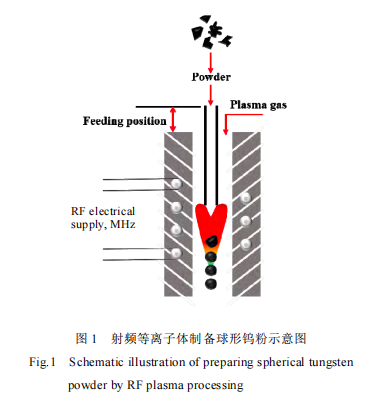
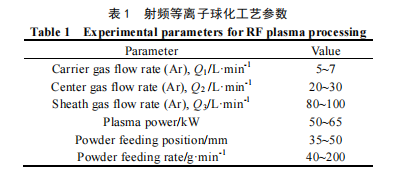
results. The raw material had a laser particle size of D10 = 37.403 μm, D50 = 69.572 μm, and D90 = 163.219 μm. In addition, three types of irregular tungsten powders (2#, 3#, and 4#), with a laser particle size of D50 ≈ 20 μm and different particle shapes, were selected as raw materials to study the effect of the raw tungsten powder state on the ballization results. All selected raw tungsten powders werecommercially available. The raw tungsten powders were ballized using an RF plasma ballization system, which mainly consists of a plasma generator, a powder feeding device, a collection device, and a cooling device [20]. The system uses argon as the working gas to establish a stable argon plasma arc, while argon is also used as the carrier gas to inject the raw tungsten powder into the plasma chamberthrough a powder feeder. Under heat transfer mechanisms such as radiation, convection, and conduction, the powder is rapidly heated to complete or partial melting. The molten powder particles rapidlysolidify and shrink under the action of surface tension, forming dense spherical powder [21]. The principle of RF plasma ballization of powders is shown in Fig. 1, and the specific process parameters for the tungsten powder ballization experiments are listed in Table 1. The experimental process for preparing spherical tungsten powder by RF plasma ballization mainly consists of four steps:
(1) Pretreatment of the raw tungsten powder: the raw powder was dried in a vacuum drying oven at 150 °C for 10 h to reduce the moisture content of the powder particles;
(2) Establishment of a stable plasma torch, with the maximum temperature of the temperature field reaching 104 K;
(3) Preparation of spherical tungsten powder: the dried raw tungsten powder was fed into the plasma torch through the powder feeder, and the powder particles rapidly underwent three processes inside the
plasma torch: endothermic heating, melting, and solidification;
(4) Collection and post-treatment of the spherical tungsten powder after ballization.
In the selective laser melting (SLM) forming process, the quality of powder spreading directly affects the performance of the subsequently formed products. Factors such as powder morphology, particle size, and particle size distribution all affect the powder spreading effect. In this experiment, a self-made powder spreading device was used, and four types of powders—2#, 2# ballized, 4# ballized, and 1#ballized—were selected for powder spreading experiments. The powders were then photographed with a digital camera, and the powder spreading effect of the 1# ballized powder was observed by scanning electron microscopy (SEM). The particle size and particle size distribution of the tungsten powder before and after ballization were measured using a Malvern Scirocco 2000 laser particle size analyzer. The morphology of the powder particles was observed using a Nova Nano SEM450 scanning electron microscope. The tap density, bulk density, and flowability of the powders before and after ballization were
tested using a BT-100 powder comprehensive property tester. Pure tungsten thin-walled parts were fabricated using an EOS M280. The ballization rate of the tungsten powder particles after ballization was calculated by observing the particles using a scanning electron microscope and statistically determining the percentage of spherical powder particles among the total powder particles after ballization. Each sample was randomly sampled and counted three times, and the average value was taken as the ballization rate of the sample.
2.1 Spheroidization of irregular coarse-grained tungsten powder (1#)
2.1.1 The influence of feeding rate on spheroidization results
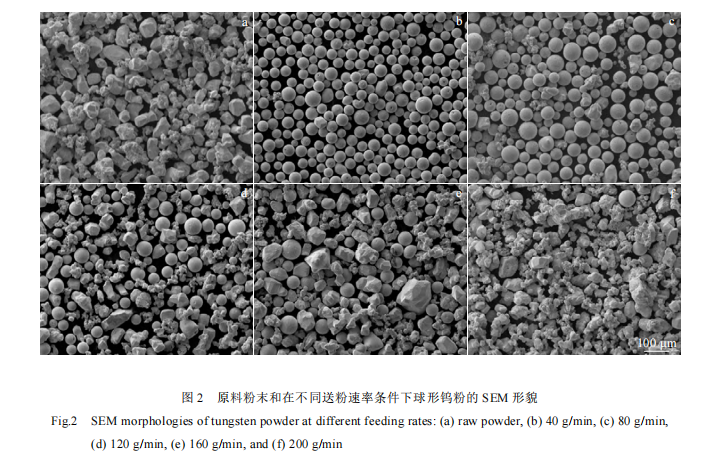
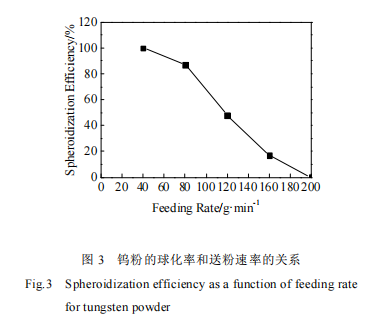
From the before-and-after pictures of the spheroidization of coarse-grained tungsten powder (Figure 2), it can be clearly seen that the raw tungsten powder (Figure 2a) exists in an irregular polygonal state, is uniformly dispersed, and the edges and sharp corners of the particles are obvious. The laser particle size distribution of the powder particles ranges from 37.403 μm (D10) to 163.219 μm (D90). Keeping other spheroidization process parameters constant, the influence of the feeding rate on the spheroidization effect was studied. SEM images of the tungsten powder after spheroidization treatment under different feeding rates are shown in Figures 2b to 2f. When the feeding rate was 40 g/min (Figure 2b), after plasma spheroidization treatment, smooth surface, high sphericality, and good dispersion of spherical tungsten
powder were obtained, and the spheroidization rate could reach 100%. When the feeding rate was 80 g/min (Figure 2c), a small number of raw particles were obviously not spheroidized, the edges of a small number of raw particles were no longer obvious, and a few particles presented an ellipsoidal shape. The spheroidization rate was 87%. When the feeding rate was 120 and 160 g/min (Figures 2d and 2e), thelarger tungsten powder particles still existed in an irregular polygonal raw state, and the spheroidization rates were 48% and 17%, respectively. When the feeding rate was 200 g/min (Figure 2f), almost no powder particles were spheroidized, and the spheroidization rate was almost 0%. This result is consistent with other research conclusions [23]. The relationship between the spheroidization rate of tungsten powder and the feeding rate is shown in Figure 3. With the increase of the feeding rate, the spheroidization rate decreased significantly. Under the condition that other spheroidization process parameters remained constant, a stable temperature field was formed in the plasma chamber. Within a certain feeding rate range, the powder particles could achieve complete spheroidization. With the increase of thefeeding rate, the amount of powder particles passing through the plasma torch per unit time increased, and more energy was required to spheroidize them. However, the energy provided by the temperature field remained constant and could not meet the energy requirements for the complete spheroidization of all powder particles, resulting in some powder particles not fully absorbing heat and achieving complete
spheroidization. In addition, the increase in the feeding rate would cause some tungsten powder particles to deviate from the high-temperature zone in the plasma torch, resulting in insufficient heat absorption of the powder, which is also one of the reasons for the low spheroidization rate.
2.1.2 The Influence of Powder Supply Position on the Degree of Spheroidization
The schematic diagram of the powder supply position is shown in Figure 1. During the plasma spheroidization process for preparing spherical tungsten powder, the raw tungsten powder is carried by the carrier
gas Q1 into the plasma torch. The total length of the powder supply device remains constant. Under the condition of maintaining the same powder supply rate and carrier gas volume, the height of the powder
supply position directly affects the running distance of the raw tungsten powder in the plasma torch and the absorption time.
Under the condition that all other ballizing process parameters remain the same (energy input and carrier gas volume being constant values), different powder feeding positions result in different ballizing effects
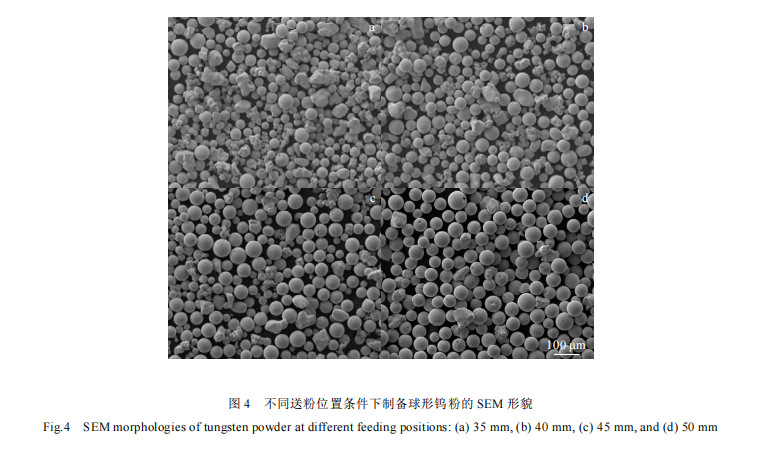
of tungsten powder. Figures 4a, 4b, 4c, and 4d show the morphological characteristics of the ballized tungsten powder at powder feeding positions of 35, 40, 45, and 50 mm, respectively. At the powder feeding
position of 35 mm, some particles are partially ballized while others remain in the raw powder state. The sharp and angular edges on the particle surfaces are clearly visible, and the ballizing rate is 48%. At the
powder feeding position of 40 mm, the ballizing effect is improved compared to 35 mm, but some particles still have irregular polygons, and a few particles do not undergo complete ballizing due to insufficient
heat absorption, with a ballizing rate of 63%. At the powder feeding position of 45 mm, the surface of the spherical tungsten powder particles is smooth, and the ballizing rate significantly increases to 75%, with
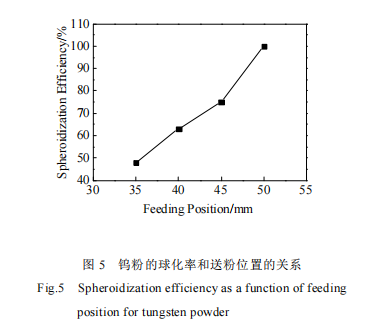
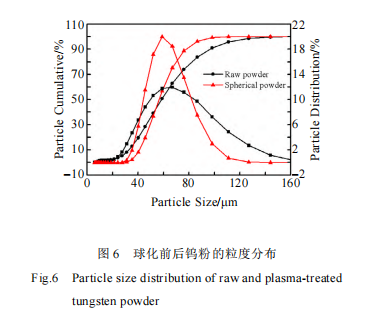
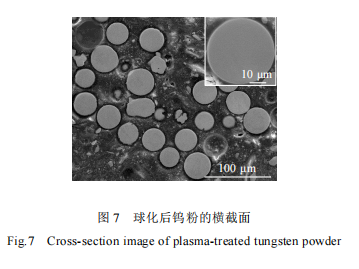
a few ballized particles having pits or obvious incomplete melting phenomena. At the powder feeding position of 50 mm, the majority of particles have a smooth surface and exist in a spherical state, with a ballizing rate close to 100%. The relationship curve between ballizing rate and powder feeding position is shown in Figure 5. As the powder feeding position increases, the ballizing rate significantly improves. This is because, under the condition that other ballizing process parameters remain constant, the longer the distance that the raw tungsten powder travels in the plasma torch and the longer the time it spends in the high-temperature zone, the more heat it absorbs, and the greater the possibility that the raw tungsten powder melts into a spherical shape. Considering equipment safety, the powder feeding position range is controlled within 50 mm. The particle size and particle size distribution of the raw tungsten powder and the powder feeding rate of 40 g·min-1 are shown in Figure 6. After ballizing at a powder feeding rate of 40 g·min-1, compared to the raw tungsten powder, the particle size of the spherical tungsten powder is relatively reduced, and the particle size distribution is significantly concentrated. Figure 7 showsthe cross-sectional morphology of the spherical tungsten powder with a ballizing process parameter powder feeding rate of 40 g·min-1. The tungsten powder particles after ballizing are dense internally an have no holes. After testing, the fluidity of the ballized tungsten powder before and after ballizing increased from 14.1 s·(50 g)-1 to 5.9 s·(50 g)-1, and the bulk density increased from 5.98 g·cm-3 to 10.99 g·cm-3. Compared to the conventional morphology tungsten powder particles, the arch bridge effect of the spherical tungsten powder particles is weakened, and the fluidity and bulk density are significantly improved.
2.2 The influence of three different tungsten powder (2#, 3#, 4#) raw material states on the spheroidization results
Three tungsten powders with similar laser particle size measurements but different particle shapes (2#, 3#, 4#) were selected and subjected to spheroidization treatment under the same spheroidization process
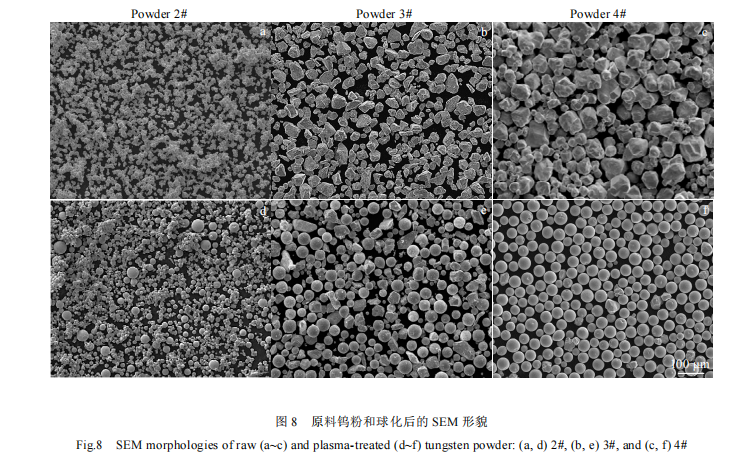
parameters. The particle morphologies before and after spheroidization are shown in Figure 8. 8a-8c represent the morphologies of the three raw powder particles, and 8d-8f represent the particle morphologies after spheroidization of the three powders. The D50 of 2# tungsten powder is 23.098 μm, with a small single particle size and obvious severe agglomeration among the particles, without fluidity. After spheroidzation, the spheroidization effect was not obvious, and most of the powder particles did not obtain spheroidization, only a few particles obtained spheroidization, and still existed in a agglomerated state. 3#powder has obvious sharp corners and edges, with many plate-like and rod-like particles, good particle dispersion, and D50 of 21.053 μm, with a fluidity of 12.04 s·(50 g)-1. After spheroidization, most of the particles were in a spherical state, with some particles still existing in a rod-like or plate-like form, the sharp corners and edges were no longer obvious, and the spheroidization effect was better. 4# powder is medium-sized tungsten powder, with a relatively regular shape, without agglomeration, and D50 of 25.901 μm, with a fluidity of 10.83 s·(50 g)-1. After spheroidization, almost all the particles were in a spherical
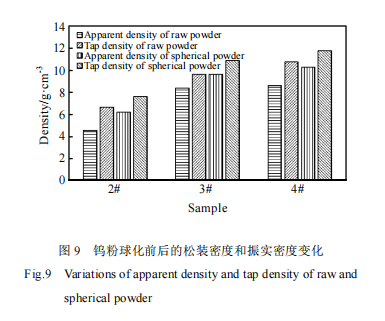
state, with a smooth surface, and the spheroidization rate was close to 100%. In the process of spheroidizing tungsten powder by radio frequency plasma, in terms of raw material, the particle size and raw material state of the tungsten powder affect the fluidity of the tungsten powder and the dispersion state of the tungsten powder in the plasma torch. The van der Waals force between the fine-grained raw tungsten powder particles is strong, they mutually adsorb and tend to exist in an agglomerated state, which is not conducive to spheroidization treatment. Meanwhile, compared with regular particles, the particles with similar diameters of rods and plates are more prone to spheroidization. The loose bulk density and compact density of the three powders before and after spheroidization are shown in Figure 9. After spheroidization treatment, the loose bulk density and compact density of the three powders were all improved compared to the raw powder. The particles of 2# raw powder mutually adsorb and agglomerate, the friction force between them is large, and there is no fluidity. After spheroidization, some of the powder particles were spherical, with a fluidity of 24.01 s·(50 g)-1. The fluidity of 3# and 4# powders increased from 12.04 and 10.83 s·(50 g)-1 before spheroidization to 9.89 and 7.50 s·(50 g)-1 after spheroidization. After spheroidization treatment, the tungsten powder particles changed from irregular shapes
to regular spherical shapes, the arch bridge effect between particles weakened, the friction force decreased, and the fluidity was improved. When the powder is piled up, the contact area is small, the gaps between particles are reduced, and the loose bulk density and compact density are improved.
2.3 The influence of powder state on the powder spreading effect of selective laser melting fabricated parts
Based on the powder spreading principle of the selective laser melting technology equipment EOS M280, this study designed an experimental device to simulate the powder spreading process and conducted
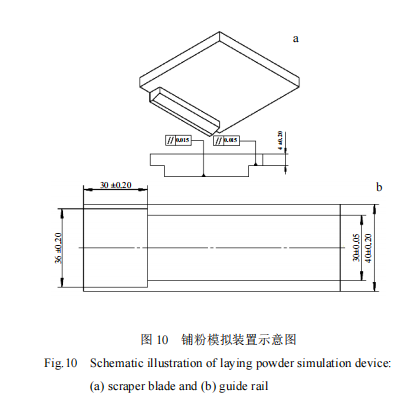
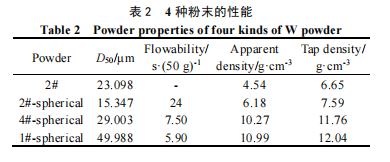
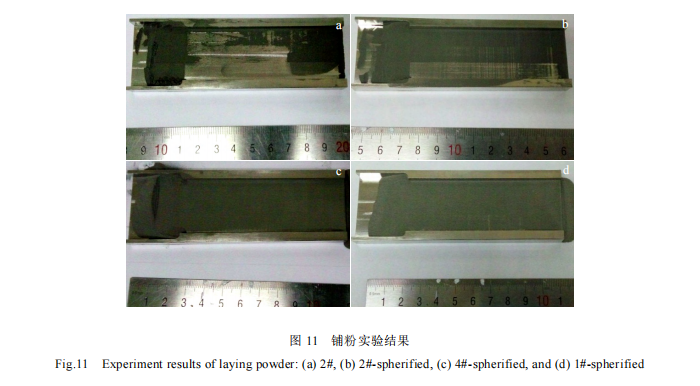
research on the powder spreading effects of different powders. The powder spreading experimental device used a guide rail as the powder bed and a scraper for powder spreading. The schematic diagram of the scraper and the guide rail is shown in Figure 10. There are 3 different processing depths of 20, 50, and 80 μm evenly distributed along the width direction of the guide rail to achieve 3 different powder layer thicknesses. During the powder spreading experiment, the powder was placed at the left end of the guide rail, and the scraper was used to spread the powder from left to right under a certain force. The powder spreading effect was observed. The performance of the 4 selected powders 2#, 2# spheroidized, 4# spheroidized, and 1# spheroidized with D50, fluidity, bulk density, and compaction density are shown
in Table 2. The macroscopic results of the powder spreading experiments for the 4 powders 2#, 2# spheroidized, 4# spheroidized, and 1# spheroidized are shown in Figure 11. The powder spreading of 2# is uneven, with severe intermittent phenomena, and the powder spreading effect is poor. The intermittent phenomena are still serious at a layer thickness of 80 μm. This is because the particles of 2# powder have irregular shapes and no fluidity, which is not conducive to the realization of the powder spreading process and is not suitable for the preparation of fabricated parts using selective laser melting technology.
The spheroidization rate of 2# spheroidized powder is not high, and there is local agglomeration of particles. During the powder spreading process, the powder cannot be well spread at a layer thickness of 20 μm, but it is better than that of the 2# raw material powder. The intermittent phenomena are improved at a layer thickness of 80 μm. From a macroscopic perspective, at a layer thickness of 20 μm, the powder
spreading effect of 4# spheroidized powder is good, the powder is spread relatively evenly, and there are no obvious intermittent phenomena. This is because 4# spheroidized powder has a high spheroidization
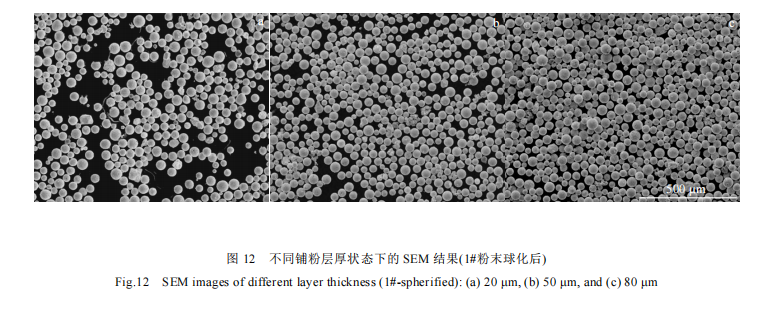
rate and good fluidity, resulting in a better powder spreading effect. The D50 of 1# spheroidized powder is 49.988 μm, with a large particle size and good fluidity. At a powder layer thickness of 20 μm, the powder spreading is uneven, and there is a certain degree of intermittent phenomena. As the powder layer thickness increases, when it reaches 80 μm, the powder spreading effect improves, and uniform powder spreading can be achieved. Combining the scanning electron microscope results of the powder spreading state under the distribution of 1# spheroidized after spheroidization, it can be clearly seen that at a powder layer thickness of 20 μm (Figure 12a), the gaps between the powder particles on the guide rail are large. As the powder layer thickness increases from 20 μm to 50 μm, the powder spreading effect gradually improves, and when the powder layer thickness reaches 80 μm, uniform powder feeding can be achieved.
2.4 Application of Spherical Tungsten Powder in 3D Printing of Thin-Walled Tungsten Products
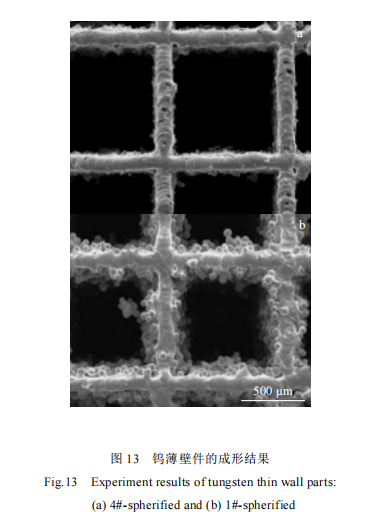
Two types of spherical tungsten powders, 4# spheroidized and 1# spheroidized, were selected for the forming experiment of pure tungsten thin-walled parts using EOS M280. The experiment was conducted under nitrogen protection, with a powder layer thickness of 30 μm; the laser scanning interval was 110 μm, the scanning power was 200 W, the scanning speed was 300 mm·s-1, and the substrate preheating temperature was 80 ℃. The experimental results are shown in Figure 13. From Figure 13, it can be seen that compared with the 1# spheroidized powder, the printing result of the 4# spheroidized powder show that the 1# spheroidized thin-walled formed part has low dimensional accuracy due to powder adhesion phenomenon, while the 4# spheroidized formed part has less adhesion phenomenon and a relatively
smooth surface, with high dimensional accuracy, which is suitable for 3D printing to prepare thin-walled parts.
1) In the process of preparing spherical tungsten powder by radio frequency plasma spheroidization technology, regarding the spheroidization process parameters, as the powder feeding rate increases, the spheroidization rate decreases significantly; as the powder feeding position is raised, the spheroidization rate increases significantly; the optimal spheroidization process parameters are powder feeding rate of
40 g·min-1 and powder feeding position of 50 mm. Regarding the morphology of the raw tungsten powder, under the condition of similar particle size, particles with good dispersibility and regular powder shape have higher spheroidization rate.
2) After spheroidization, the shape of tungsten powder particles is regular spherical, the surface of the particles is smooth, and the fluidity, bulk density and compacted density have been improved.
3) The powder feeding process of pure tungsten powder is mainly affected by the powder properties and the thickness of the powder layer. With good powder fluidity, the powder feeding effect is good; for the
same type of powder, as the powder layer thickness increases, the powder feeding effect improves, which is conducive to the progress of the powder feeding process.
4) The surface of the tungsten thin-walled parts prepared using 4# spheroidized tungsten powder is relatively smooth and the dimensional accuracy is high.
References: Preparation and Application of Spherical Tungsten Powder (Zhou Wuping, Zhang Yingying, Wang Xuebing, Yang Huachao, Xiong Ning, Liu Guohui, Wang Tiejun)
Star Dust Technology (Guangdong) Co., Ltd., focuses on the research and production of high-end spherical powder for radio frequency plasma spheroidization. It mainly focuses on rare and refractory metals and alloys such as tungsten, molybdenum, tantalum, niobium, hafnium, zirconium, vanadium, rhenium, etc., as well as ceramic spherical powder. It supports incoming powder spheroidization processing and particle size customization. The powder has high sphericality, low oxygen and high purity, and is suitable for processes such as SLM, MIM, thermal spraying, and target material preparation. It serves aerospace,
military, nuclear energy, medical and other fields. It has national military standard and medical system qualifications, and provides powder + printing integrated solution. For more product information, please contact Manager Hu at 13378626726.

Stardust Technology (Guangdong) Co., Ltd.

101, Building 1, Liandong Youzhi Zone, Senshuji Road, Nansha Community, Danzao Town, Nanhai District, Foshan City,Guangdong Pro.,China
Tel:13378621675;13318326185;18033239934;13318326187;13378626726
QR code